

When light hits a textured surface, a wall stops being a boundary: it becomes an experience. The fireplace has always been the soul of the home, a gathering point that draws the eye and anchors the room. Increasingly, it is also an architectural statement defined by surface articulation and material intelligence.
The challenge for modern homeowners and designers has always been the rigidity of traditional stone finishes: how to achieve the gravitas of a stone feature without the structural complications. Flexible Natural Stone by Angkop Corp is a thin, flexible mineral panel that carries the look and feel of quarried stone, installed over a prepared substrate rather than built up as masonry. Flexible Natural Stone is the architectural surface; MCM describes the material technology beneath it.
The Foundation of Fireplace Design: Safety First
Before the aesthetics, the foundation of fireplace design is safety. When you are dealing with a heat-adjacent environment, the surface is only one part of the story: the fireplace manufacturer's installation manual, the applicable code, and the complete wall assembly govern what is permitted around the firebox. All clearances and non-combustible substrate extents belong to the appliance manufacturer and the code — never infer them from a finish.
On fire performance, a 2.5 mm Modified Clay Material specimen tested in accordance with ASTM E84-24 reported FSI 0 and SDI 5, meeting the Class A interior wall and ceiling finish category for that tested specimen; the full wall assembly is reviewed separately.
For a deeper dive into the detailing questions, see the article on detailing around fireplaces, feature walls, and interior transitions. Now, the ten ideas.
1. The Monolithic Vertical Rhythm
The trend is toward vertical, floor-to-ceiling application. Large-format panels create a seamless surface that draws the eye upward and celebrates the height of the space.
2. The Softened Curve: The Archway Revolution
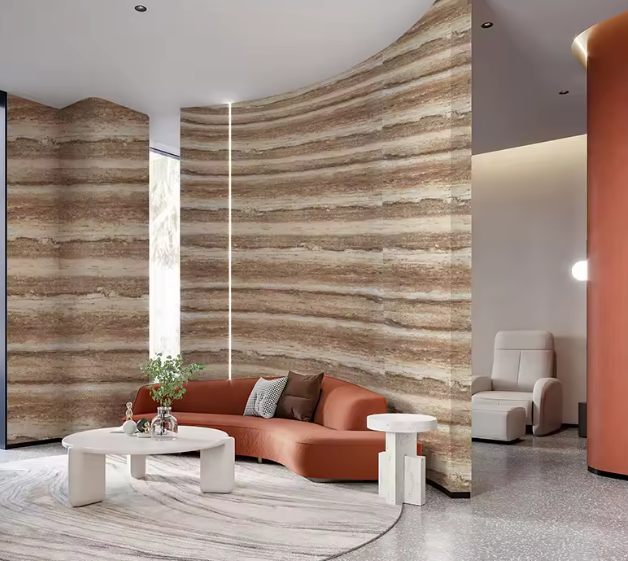
Standard flexible panels of ten feet or longer curve a full 360 degrees along their length, which allows stone to wrap rounded surrounds and arched alcoves. The large-format 3D panels, also ten feet, take a 45-degree bend. Confirm the selected format and geometry before procurement.
3. Recessed Minimalism
A recessed fireplace flush with a stone-clad wall creates a minimalist "hole in the wall" effect. The texture can carry into the fireplace return so the composition reads continuous, provided the substrate and appliance requirements are resolved first.
4. The Hearth Zone and the Surround
A defined hearth zone — bench, shelf, or hearth extension finished in the same material language — gives the surround a deliberate architectural base. Detail the edge terminations and transitions as part of the assembly.
5. Tone-on-Tone Texture Interplay
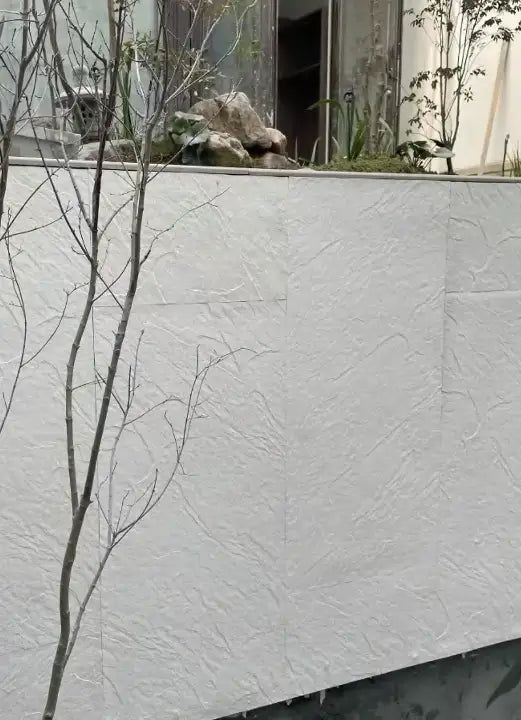
Move away from high-contrast palettes toward monochromatic layering. Pair a light-grey stone fireplace wall with slightly darker grey furnishings; the visual rhythm comes from texture rather than colour.
6. Material Pairing: Stone with Concrete
Blending stone texture with smooth concrete elements suits loft and industrial interiors. The dialogue between materials is part of the design; coordinate the finishes as one composition.
7. Moody Slate and Charcoal Enclaves
There is an undeniable allure to a dark, dramatic fireplace. A deep-toned slate or charcoal panel makes the fire's glow read with intensity — a mood of sanctuary and quiet power.
8. The Sculpted Relief Aesthetic
For a naturalistic look, sculpted relief formats offer surface articulation that reads like exposed geology. On a fireplace wall, the result is a focal point that feels unearthed rather than applied.
9. Geometric Precision with Stacked Slate
The classic stacked-stone look continues with tighter seams and consistent colour grading. Plan seams, corners, and terminations before installation so the geometry stays disciplined.
10. The Integrated Media Wall
The fireplace often lives directly beneath a television. A thin-profile finish suits these compositions because the build-up is minimal; coordinate recessed wiring and flush-mount brackets with the wall assembly as usual.
Why Specifiers Specify It
- Material: a mineral-based panel formed with modified clay technology, applied over a prepared substrate.
- Surface: approximately 2-5 mm depending on product profile, installed as a finish, not a structural element.
- Geometry: standard panels of ten feet or longer curve a full 360 degrees along their length; large-format 3D panels take a 45-degree bend.
- Documentation: current fire-performance and installation documentation is available through the Angkop Resource Hub.
Bring the Design Together
A fireplace upgrade is among the most impactful renovations a living area can receive. Choose the composition, plan the assembly, and let the texture carry the room.
Whether you are drawn to refined linear travertine or a boulder-sculpted relief, the possibilities are as flexible as the format. Explore the Flexible Stone Sample Pack to review textures in your own light, request technical documentation for specification work, or contact specification support to talk through a specific wall.
The winter fireplace is a study in texture and light. It is where the room gathers — and where a considered surface decision earns its keep every evening.

0 commentaire