

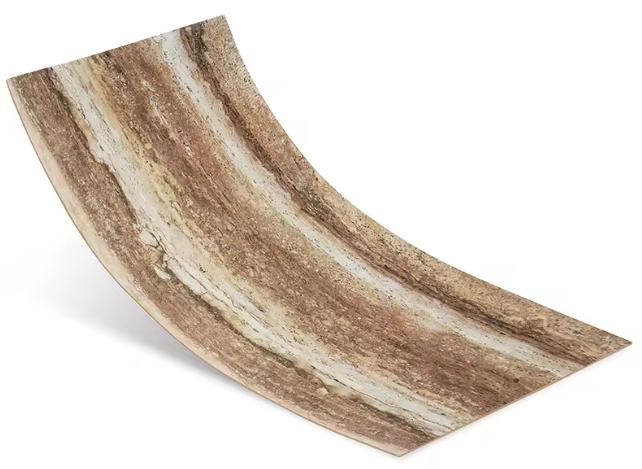
Flexible Natural Stone by Angkop Corp is a thin-profile architectural surface installed over a prepared wall or other approved receiving surface. The panel may be only approximately 2–5 mm thick, depending on the product profile, so the substrate remains visible in the finished result. It does not replace framing, sheathing, backing, or the structural design of the wall assembly.
The practical rule is simple: the surface finish is only as reliable as what it is bonded to. If the wall moves, sheds dust, contains moisture, or has ridges and hollows, those conditions can affect alignment, contact, adhesion, and the appearance of the finished installation.
MCM describes the material technology beneath it. Flexible Natural Stone is the architectural surface; MCM describes the material technology beneath it.
This guide explains how to select and prepare the receiving substrate before installation. It follows the application principles in the Installation Guide and the technical resources available through the Resource Hub. Substrate products and adhesives are not Angkop products. Their suitability must be confirmed from the current technical data issued by their manufacturers and from the project specification.
Why the substrate carries the result
Flexible Natural Stone follows the geometry of the prepared surface. That is useful when a design includes a gentle radius, a column, a return, or another shaped condition. It also means that the panel will not correct a poorly prepared wall.
A substrate that is uneven can telegraph irregularities through a thin finish. A substrate that flexes can place movement at the bond line. Dust, grease, loose paint, or a weak surface layer can prevent the adhesive from contacting a sound base. Moisture can also change the condition of the receiving surface or affect the adhesive system selected for the installation.
Before panels arrive at the wall, the site team should answer four questions:
- Is the substrate suitable for this location and assembly?
- Is it sound enough to support the finish without excessive movement?
- Has the surface been prepared for the selected adhesive?
- Are the surrounding site conditions ready for bonding and finishing?
If any answer is uncertain, pause the installation and resolve the condition before covering the wall.
Substrates used in practice
The appropriate substrate depends on the location, the wall assembly, moisture exposure, movement, and the requirements of the selected adhesive. The following substrate categories are identified in Angkop’s published guidance and resource material.
Finished drywall
Finished drywall may suit interior feature walls and other dry interior applications when it is properly supported, sound, clean, dry, and suitable for the selected adhesive.
“Finished” does not mean that every painted or decorated wall is ready to receive panels. The finish must be firmly attached, free of dust and grease, and compatible with the adhesive system. Any loose paint, damaged joint compound, soft areas, or local repairs need to be assessed before installation.
Drywall is also part of a larger wall assembly. It does not replace the framing or backing required to support the wall. Where the wall is curved, the substrate must already be formed to the intended geometry and remain stable under the installation conditions.
Cement board and fibre-cement board
Cement board and fibre-cement board are commonly considered where a more moisture-tolerant or rigid board substrate is required by the assembly. They may be used in selected interior, wet-area, commercial, or exterior conditions when the board, fasteners, joints, membranes, and adhesive system are coordinated.
The board must be installed and finished according to its manufacturer’s current instructions before Flexible Natural Stone is bonded to it. Confirm that the specific board is approved for the location and that the selected adhesive is compatible with the board surface.
A board can look complete while still having movement at joints, fasteners, edges, or transitions. Those areas should be reviewed as part of the complete substrate rather than treated as isolated surface defects.
Masonry and concrete
Masonry and concrete can provide a stable receiving surface for interior or exterior applications when they are sound, appropriately cured, clean, dry, and free of bond-breaking contaminants.
Inspect for crumbling areas, hollow or delaminated sections, loose mortar, efflorescence, coatings, curing compounds, sealers, oil, and other materials that may interfere with adhesion. A painted or sealed masonry surface is not automatically equivalent to clean, bondable masonry.
Concrete and masonry may also contain local projections, recessed repairs, form marks, or changes in texture. These conditions should be corrected or otherwise addressed according to the project specification and the technical data for the selected preparation and adhesive products.
Approved exterior sheathing
Exterior sheathing may be part of a suitable exterior wall assembly when the specific sheathing product and the complete wall design allow the application. This is not a blanket approval for every sheathing product or exposure.
Confirm the sheathing type, weather-control layers, joints, fasteners, edges, transitions, and surface condition with the wall-system requirements. The exterior assembly must address moisture management and movement independently of the Flexible Natural Stone surface.
For exterior work, do not rely on a general interior installation detail. Review the current product, substrate, adhesive, and building-code requirements for the actual exposure.
OSB, plywood, and MDF board substrates
OSB, plywood, and MDF may be encountered as part of interior walls, millwork, furniture faces, display elements, or other board-based construction. Their use requires more than simply confirming that the board is flat.
The specific board must be appropriate for the intended vertical application, adequately supported, dimensionally stable for the location, and compatible with the adhesive system. OSB and plywood may have face treatments, surface texture, or construction joints that affect bonding. MDF must be suitable for the intended use and protected from conditions that could cause it to swell or lose stability.
Confirm board selection and preparation from the board manufacturer, adhesive manufacturer, and project specification. Do not assume that a board product used successfully in one assembly is suitable in another.
What a receiving substrate must be like
The Installation Guide identifies the central requirements: the substrate must be stable, clean, dry, properly supported, and suitable for the selected adhesive. On site, those terms have practical meaning.
Clean
A clean substrate has no dust, grease, oil, loose particles, weak coatings, or construction residue at the bond surface. Dust from sanding or cutting can remain on a wall even when the surface looks finished. Cleaning should be completed after other dusty work and before adhesive preparation.
Dry
A dry substrate has no visible dampness, standing water, active leaks, or unresolved moisture condition. Dryness is not a substitute for moisture management. In wet areas and exterior assemblies, the wall still needs the appropriate waterproofing, weather-control, drainage, and transition details required by the project.
Any moisture-related requirement must be confirmed from the substrate and adhesive manufacturers’ current technical data and the project specification.
Flat
A flat substrate presents a consistent plane without ridges, abrupt steps, deep depressions, open joints, or irregular repairs that could affect panel contact. Because the surface is thin, the receiving plane matters to both the bond and the visual alignment.
Flatness requirements vary with the panel profile, substrate, adhesive, and installation condition. Do not use a generic tolerance in place of the current technical documentation. Correct surface deviations using materials and methods approved for the substrate and adhesive system.
Structurally sound
A structurally sound substrate is firmly attached to the wall assembly and free of crumbling, delamination, hollow areas, loose board sections, or failed repairs. It can support the finished surface and the adhesive without breaking down at the bond line.
A sound surface is not necessarily a structural wall. Framing, sheathing, fasteners, and backing remain the responsibility of the wall assembly.
Free of excessive movement
The substrate should not flex, shift, vibrate, or move excessively under normal service conditions. Check for movement at board joints, wall transitions, corners, openings, curved framing, and existing finishes.
A flexible finish can follow an intentional radius, but it should not be used to conceal uncontrolled movement. If the wall moves or sounds hollow, identify and repair the underlying condition before installation.
New construction and retrofit conditions are different
On a new build, substrate preparation is usually coordinated before the wall is closed or handed over for finish installation. Confirm the board type, fastening, joint treatment, framing geometry, required membranes, electrical boxes, blocking, and access for inspection. The installation sequence should leave the receiving surface protected from later trades.
New construction also creates a useful hold point: inspect the wall after sanding, patching, painting, or other finishing work, not only when the board is first installed.
A retrofit starts with uncertainty. Existing walls may contain multiple coatings, previous repairs, tile, wallpaper, dust, moisture damage, or concealed movement. The first task is to determine what the existing finish is attached to and whether it can remain part of the receiving assembly.
Do not bond over an existing finish simply because it appears intact. Test and inspect representative areas, remove weak or incompatible layers, and repair the base where required. If the existing assembly cannot be verified, expose enough of the wall to understand the condition or obtain qualified project-specific advice.
Site conditions and installation sequence
Substrate preparation should be part of the site schedule, not a last-minute task. A practical sequence is:
- Confirm the location, substrate type, wall geometry, and assembly requirements.
- Complete framing, board installation, repairs, joint treatment, membranes, and other concealed work.
- Protect the prepared substrate from later dust, impact, moisture, and contamination.
- Dry-plan the panels, cuts, openings, seams, corners, and terminations.
- Confirm the adhesive is approved for the selected panel, substrate, and location.
- Prepare the receiving surface in accordance with the substrate and adhesive manufacturers’ current instructions.
- Install only when the site conditions are suitable for the adhesive and the assembly.
- Protect the finished surface while adjacent trades complete their work.
At fireplaces, wet areas, ceilings, exterior walls, and other higher-consequence locations, coordinate clearances, support, moisture control, movement, and code requirements separately. The surface finish does not replace those assembly responsibilities.
For documented fire-performance information, a 2025 SGS report documents a 2.5 mm Modified Clay Material specimen tested in accordance with ASTM E84-24, reporting FSI 0 and SDI 5, meeting the Class A interior wall and ceiling finish category for that tested specimen. The full wall assembly is reviewed separately. See the ASTM E84 documentation for the scope of the available information.
Practical specification checklist
Substrate type
- Confirm the receiving substrate: finished drywall, cement board, fibre-cement board, masonry, concrete, approved exterior sheathing, OSB, plywood, MDF, or another specified assembly.
- Confirm that the substrate product is approved for the location and exposure.
- Confirm that the wall assembly, framing, backing, membranes, and fasteners are designed independently of the Flexible Natural Stone finish.
- Confirm compatibility between the substrate, panel, adhesive, and project conditions.
Condition assessment
- Check that the substrate is clean and free of dust, grease, oil, loose material, and failed coatings.
- Confirm that the surface is dry and that moisture-related conditions are resolved.
- Check for ridges, hollows, abrupt transitions, damaged areas, and irregular repairs.
- Check for movement, flexing, hollow areas, delamination, and loose board sections.
- Repair or replace unsuitable areas before installation.
Preparation
- Complete substrate repairs and surface preparation using products approved for the assembly.
- Confirm any required treatment from the substrate and adhesive manufacturers’ current technical data.
- Dry-plan cuts, openings, seams, corners, radii, and terminations.
- Protect the prepared surface until bonding begins.
- Keep the current Resource Hub and Installation Guide available for project coordination.
Site conditions
- Confirm that dusty, wet, demolition, and high-impact work is complete before installation.
- Confirm that the site conditions are suitable for the selected adhesive and substrate.
- Coordinate wet areas, fireplaces, ceilings, exterior walls, transitions, and penetrations separately.
- Plan protection for the installed surface during the remaining construction work.
- Request technical documentation, Request samples, or Contact specification support when the substrate or assembly requires project-specific review.

0 comments